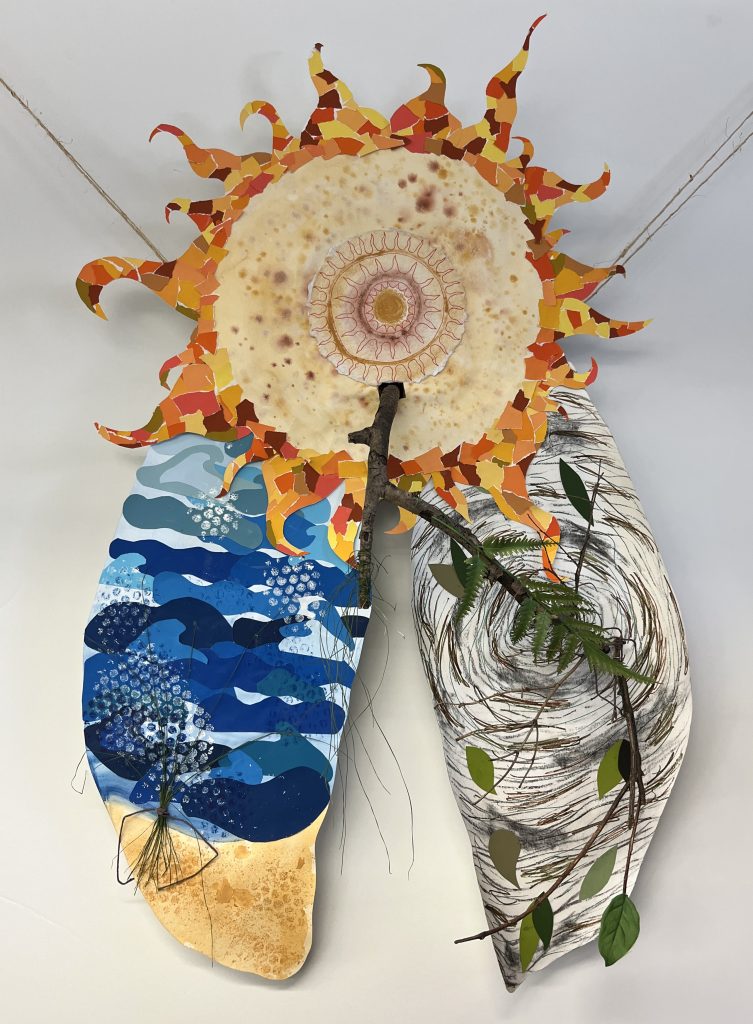
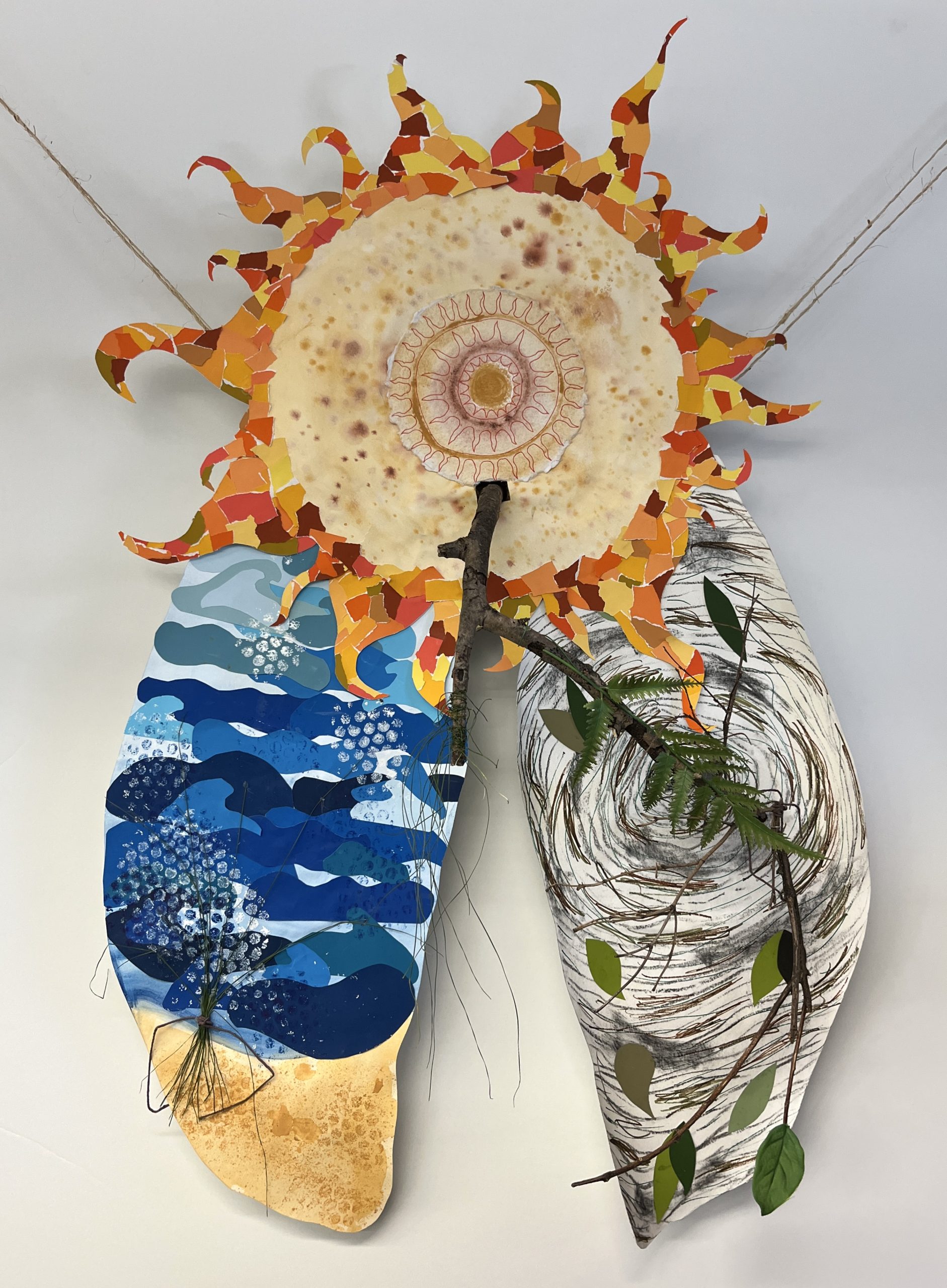
The United Nations describes the Earth’s ocean and forests biomes not only as the largest carbon sources, but the very “lungs of the planet.” The Lungs We’re Burning is a collaborative artwork illustrating the effects of climate change in these biomes through artistic and symbolic expression, exploring the connections between the sun, the ocean, and plant life, and how these systems play a role in the Earth’s climate. This work was created by Eco Art Students Lexi Kloc and Emma McBride with each of focusing on different parts of the composition. Emma’s main contribution to the piece was the left lung, ocean section, and Lexi created the right lung, forest section. The lungs are connected by a found tree branch as bronchi and both collaborated on the sun and overall research, concept, and design.
The ocean portion of the piece was inspired by the idea that marine environments act as one of the planet’s “lungs.” Research was focused on seagrass ecosystems and their role in carbon storage. Seagrass meadows absorb and store large amounts of carbon, helping regulate the climate and support biodiversity. This idea connects to the title of the work, “The Lungs We’re Burning,” which suggests that environmental damage and climate change are affecting the natural systems that help keep the planet in balance. Through this project, we wanted to visualize the ocean not just as a landscape, but as a living system that plays an essential role in sustaining life.
The ocean lung was created using layered collage paper in different shades of blue to represent waves and currents. The use of repeated shapes and patterns create a sense of depth and flow. The sand at the bottom was done on paper using natural pigment watercolor that we made earlier in the semester. Emma used recycled bubble wrap as a stamp to create texture in the piece. She also incorporated a natural hairgrass plant, connecting the imagery directly to the ecological ideas behind the work.
This right lung was inspired by research supported by the United Nations, studying the ways in which global climate crises specifically affect our forests. Forests expand over 30% of Earth’s land surface, making a home for over 75% of land-living species, overall supporting 25% of humanity. More importantly, trees, the foundation of Earth’s forests, are one of the greatest natural ‘weapons’ to fight climate change. However, with mass levels of deforestation; caused both by climate change and human negligence, their role falls under threat.
Lexi created this sector of our eco-friendly artwork by using homemade charcoal sticks, markers, collaged leaves, and natural sticks bound with twine. The charcoal sticks were carefully crafted from burnt willow vine and the sticks we used were foraged right from the Monmouth University ground. The use of these materials worked to visually convey the withering, burning, ashy crisis of climate change by deforestation. The materials used to compose the piece proved to be both ethically and purposefully practical, as well as contributing aesthetically.
The circular sun at the top of the piece was created collaboratively with layers of warm toned paper, natural pigment watercolors, and a central mandala. The sun represents the energy that drives natural systems, but it also can suggest rising global temperatures. We also incorporated a found branch placed between the sections of the piece. The branch acts as a visual connector between the sun, ocean, and the forest, emphasizing the idea that natural systems are linked. Using mixed media allowed us to combine painting, collage, and natural elements to build texture and movement in the piece.
One influence on this project is environmental artist Andy Goldsworthy, who often creates sculptures using natural materials like sticks, leaves, and stones. His work emphasizes the beauty and fragility of natural systems, and it inspired the use of organic materials within our piece. Many of the visual ideas in the work also come directly from observing nature and scientific research about ocean ecosystems and climate change.
Ultimately, this piece, along with its materials reflect both the fragility and resilience of Earth’s most critical carbon sources.